
Greek And Roman Deities On Coins-18
2026-02-03 Tue
In ancient Greek religion, Demeter is known as the Olympian goddess of agriculture and the earth's fertility. She is also called Deo and is the daughter of Cronus, who led the Titans, and Rhea, the Mother of the Gods. In Roman tradition, she is known as Ceres, which is the origin of the word "cereal."After Cronus was overthrown, Zeus became the new leader of the gods. This event marked the end of the Titan era and the start of the age of the gods. To learn more about this event, visit the following link: Greek And Roman Deities On Coins-7. Afterward, the gods received their titles, and Demeter became recognized as the goddess of agriculture. The ancient Greeks believed she taught humanity how to plant, plow, and care for the earth to grow food.
In Greek art, Demeter is usually shown as a mature woman. Her stories portray her as a loving and nurturing goddess, often linked to symbols like a cornucopia, sheaves of wheat, and a torch. She is often seen with her daughter Persephone, who is also a goddess of fertility and is the child of Zeus.
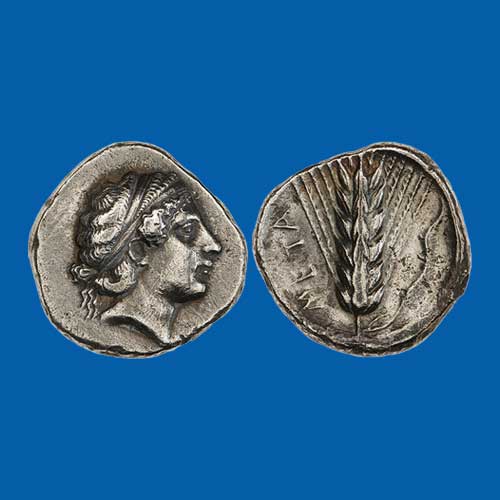
Demeter first appeared on coins in the 5th century BCE. The coin featured here is a Silver Stater from Metapontum, an ancient Greek city in Southern Italy, dating from 400 BCE to 350 BCE. Weighing 7.41 grams, the obverse features a diademed head of Demeter facing right, while the reverse displays an ear of barley with a leaf on the right. On the left side are the Greek letters ‘META’, short for Metapontum.
Interestingly, Metapontum's wealth was largely due to its ability to produce a large supply of barley, due to its fertile lands. The city, nestled in rich soil, became an important center for grain production in the ancient Mediterranean. Therefore, the people chose to feature a prominent ear of grain on their coins as a symbol of their wealth and agricultural success.
Latest News
-
Extremely Rare Silver Quarter Tanka of Kachar Monarch Yasho Narayan, Owing Allegiance to Ghatotkacha Lineage
2026-06-23 TueHidden within the misty valleys and forested hills of Northeast India lies the story of the Kacha...
-
Gun and Sword on Silver Katra Taka of Independent Kingdom of Jaintiapur King Bar Gossain II
2026-06-22 MonThe Jaintia was a prominent medieval Independent Kingdom in Northeast India, ruled ...
-
Rare and Beautiful Gold Dinar of Gauda Ruler Shashanka
2026-06-19 FriThe Gauda dynasty was an ancient kingdom in the Gauda region of Bengal. It emerged as an independ...
-
Exceptional Gold Mohur of Ahom King Swargdeo Rajeshwar Singha
2026-06-19 FriThe Ahoms were ethnic group originating from the Tai people and founder of Assamese royal dynasty...
-
Heavy Lead Coin of Hiranyakas, King Khadakama
2026-06-18 ThuThe Hiranyakas were a local dynasty that rose in the mid-3rd century CE, in Rayalaseema region th...